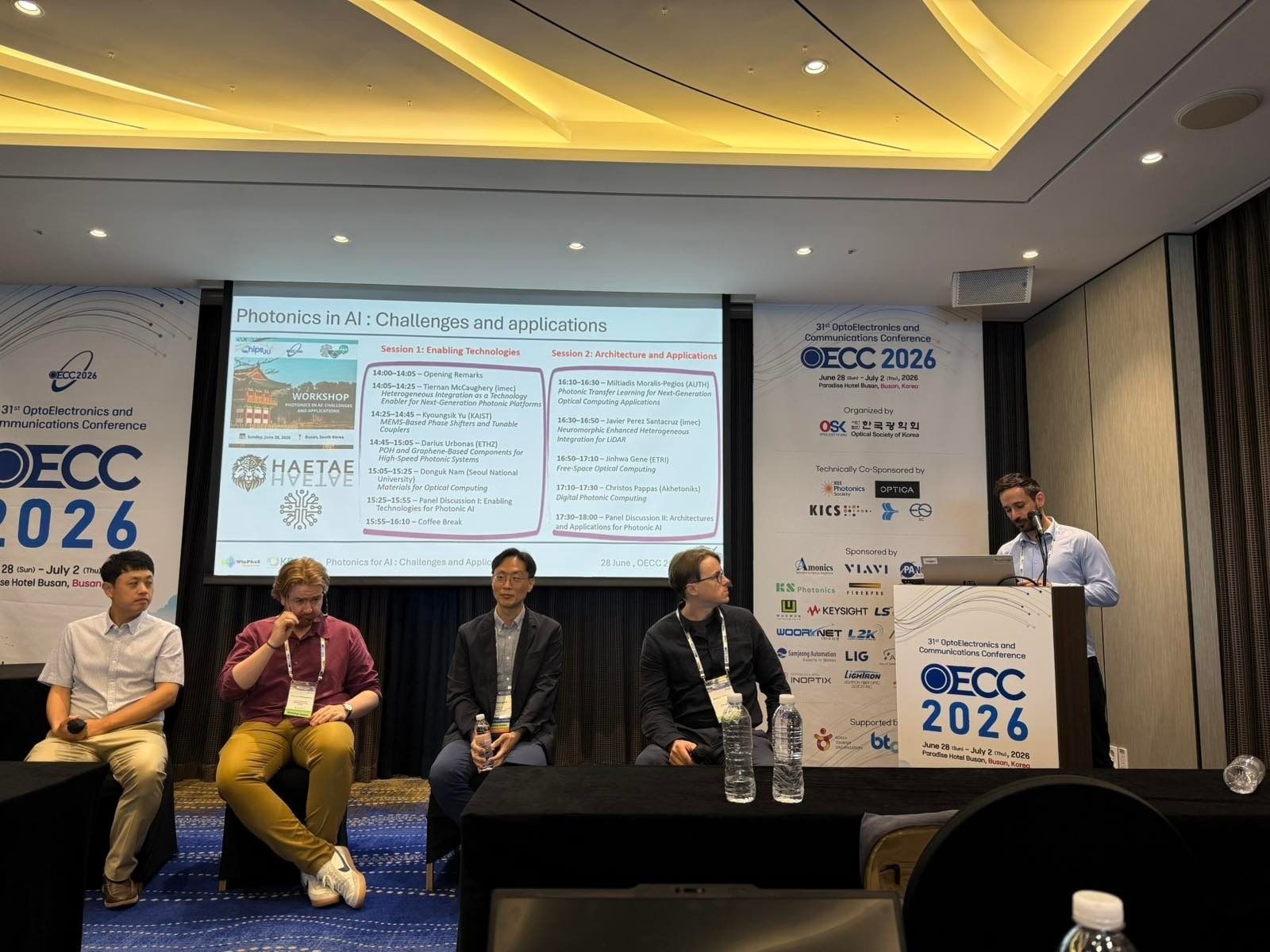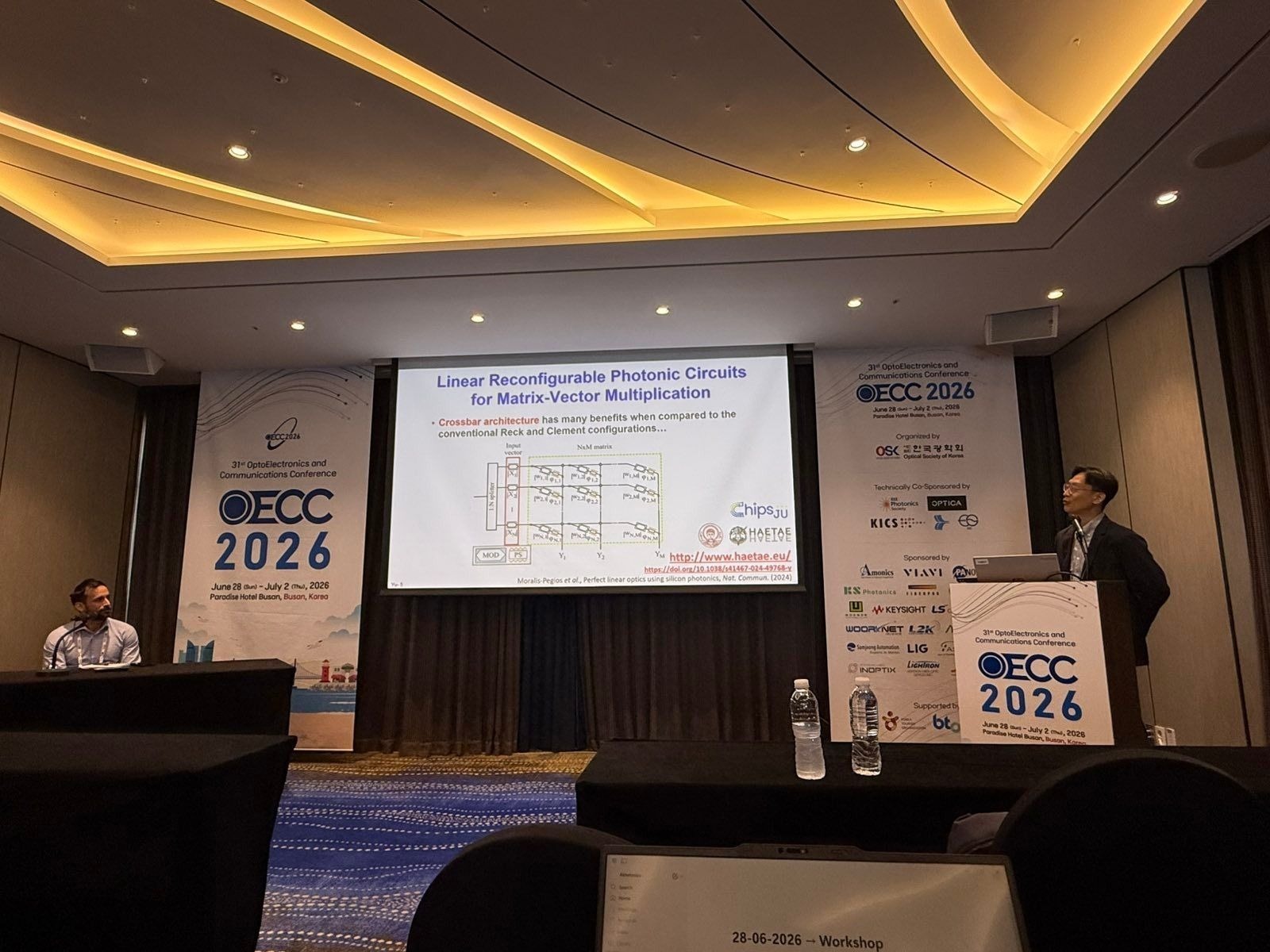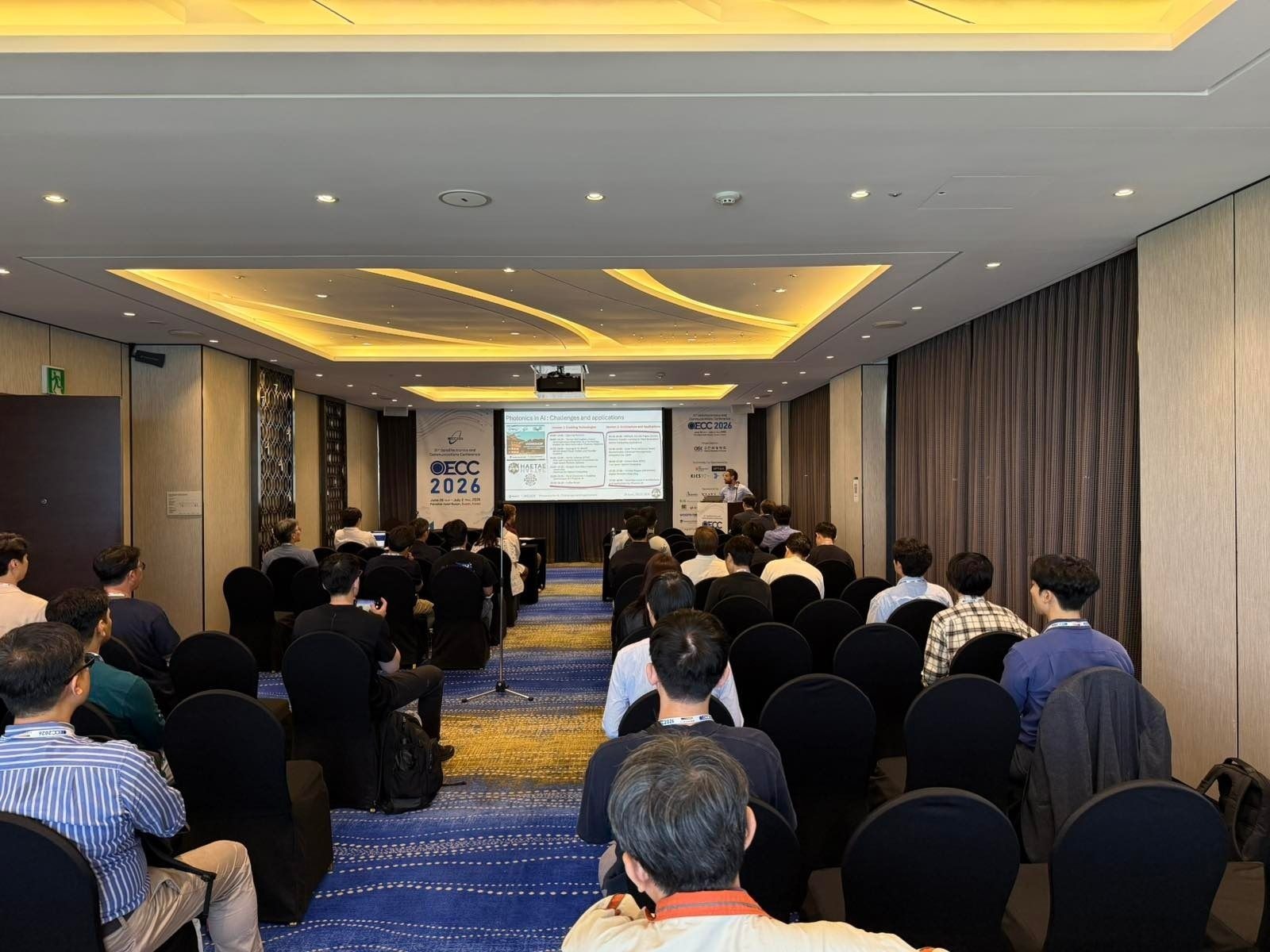
The HAETAE and NEHIL projects were pleased to bring together leading researchers from Europe and the Republic of Korea for the workshop “Photonics for AI: Challenges and Applications”.
The workshop provided a platform for researchers from academia, research institutes, and industry to discuss the challenges, opportunities, and future directions of photonic technologies for artificial intelligence, optical computing, and next-generation information processing systems.
Across two sessions, the workshop explored the complete photonic AI ecosystem - from advanced device technologies and integration platforms to architectures and emerging applications.
The first session, “Enabling Technologies”, focused on the technological foundations required for future photonic systems, including:
🔹 Heterogeneous integration for next-generation photonic platforms
🔹 MEMS-based phase shifters and tunable photonic components
🔹 Plasmonic-organic hybrid and graphene-based devices for high-speed photonic systems
🔹 Emerging materials for optical computing
We sincerely thank our speakers for sharing their insights and latest research:
• Tiernan McCaughery (imec)
• Kyoungsik Yu (KAIST)
• Darius Urbonas (ETH Zurich)
• Donguk Nam (Seoul National University)
The second session, “Architectures and Applications”, focused on translating photonic technologies into future computing systems, with presentations covering:
🔹 Photonic transfer learning for next-generation optical computing applications
🔹 Neuromorphic enhanced heterogeneous integration for LiDAR
🔹 Free-space optical computing
🔹 Digital photonic computing
We would like to thank our speakers:
• Miltiadis Moralis-Pegios (Aristotle University of Thessaloniki)
• Javier Pérez Santacruz (imec)
• @Jinhwa Gene (ETRI)
• Christos Pappas (Akhetoniks)
A highlight of the workshop was the two panel discussions, where the speakers from each session came together to exchange perspectives on the future of photonic AI. The conversations highlighted the importance of connecting expertise across the entire innovation chain — from materials and devices to integrated platforms, architectures, algorithms, and real-world applications.
This workshop represents an important step toward strengthening collaboration between European and Korean research communities.
Through the HAETAE and NEHIL initiatives, we aim to foster new partnerships and accelerate advances in integrated photonics, optical computing, and AI hardware.